← Back to Ted

Case Study  ·  Learning Design

Keynote Upskilling

Keynote training requests kept coming in. My team called them out of scope. Here’s what happened when I stopped teaching the app and started teaching the story.

Scroll to explore ↓

Chapter 1:

The Request

01

I joined my team in 2021 as an experienced teacher, excited to continue teaching in a corporate environment. My first three months were spent learning the landscape and meeting everybody. When I spoke to fellow trainers on the team, they kept mentioning small group classes. These were classes for individual teams or business units. Sometimes they would be a small, tight-knit group, other times they could be large cohorts of hundreds. A large number of our requests were for our project management software or Keynote.

I thought it odd that we would offer the same class to a team eager for something specific, but I was new, so I decided to help with these requests before proposing any earth-shattering changes to the tailored training program.

People at Apple were very eager for Keynote training. Many folks had been around for a while and were comfortable with the app, but we were bringing on more and more people who were new to the Apple ecosystem. The switch from PowerPoint or Google Slides to Keynote was a small jump, but a jump. More than anything, people would ask for training on how to “give better presentations” or, as I put it: “Our Keynotes suck, plz help.”

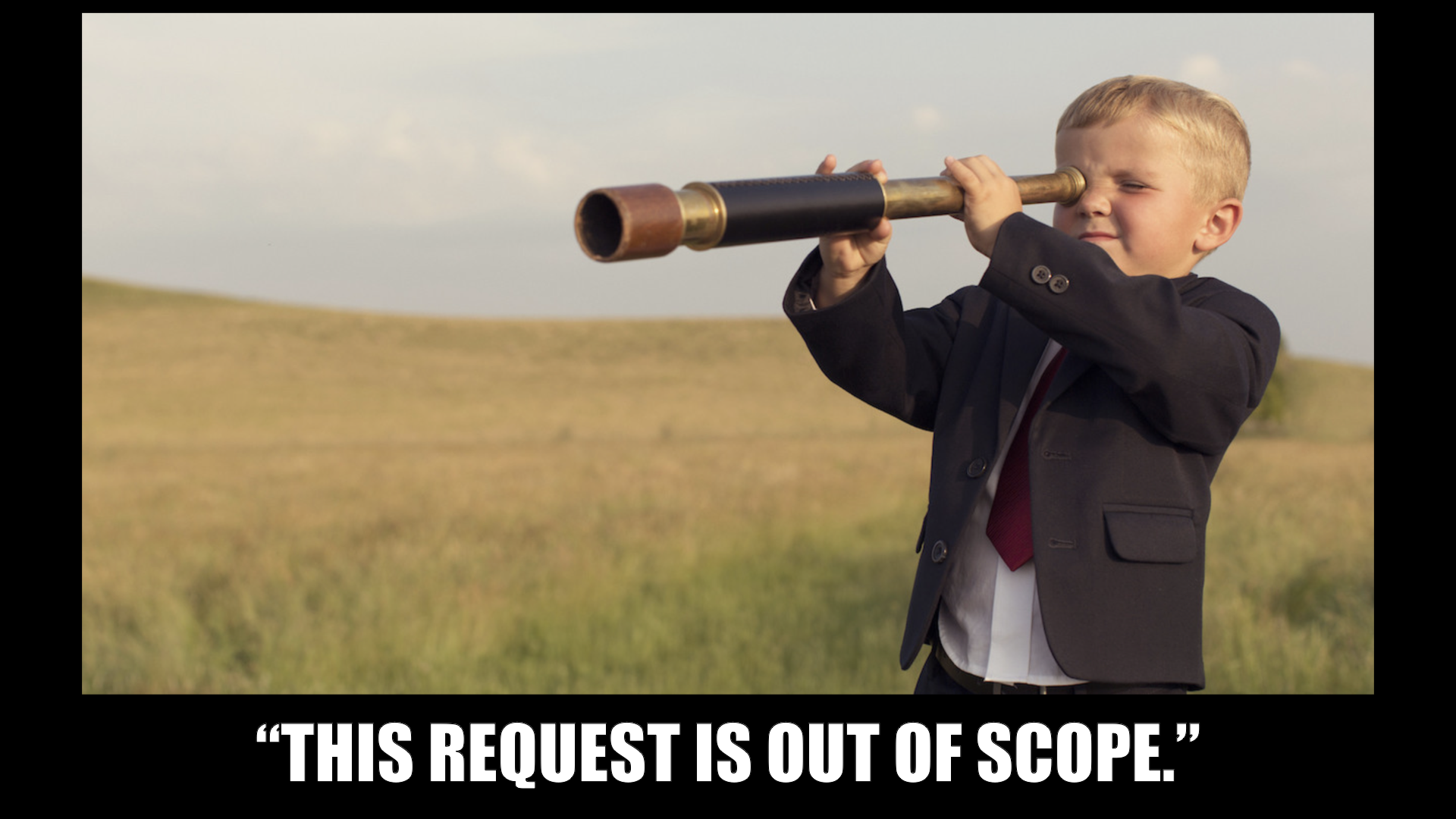
Our approach to learning was teaching app capabilities, which boiled down to interface tours and light activities showing off buttons and what they do. I noticed the “plz help” flavor of requests was growing, so I asked if we should honor them. My team told me that would be out of scope.

“Out of scope” was a talking point from my Apple Retail days, for when a customer would bring in a Google Pixel and want the screen replaced. That type of repair is out of scope; Apple doesn’t support devices made by other companies. Applying that framing to Keynote storytelling requests was missing the point.

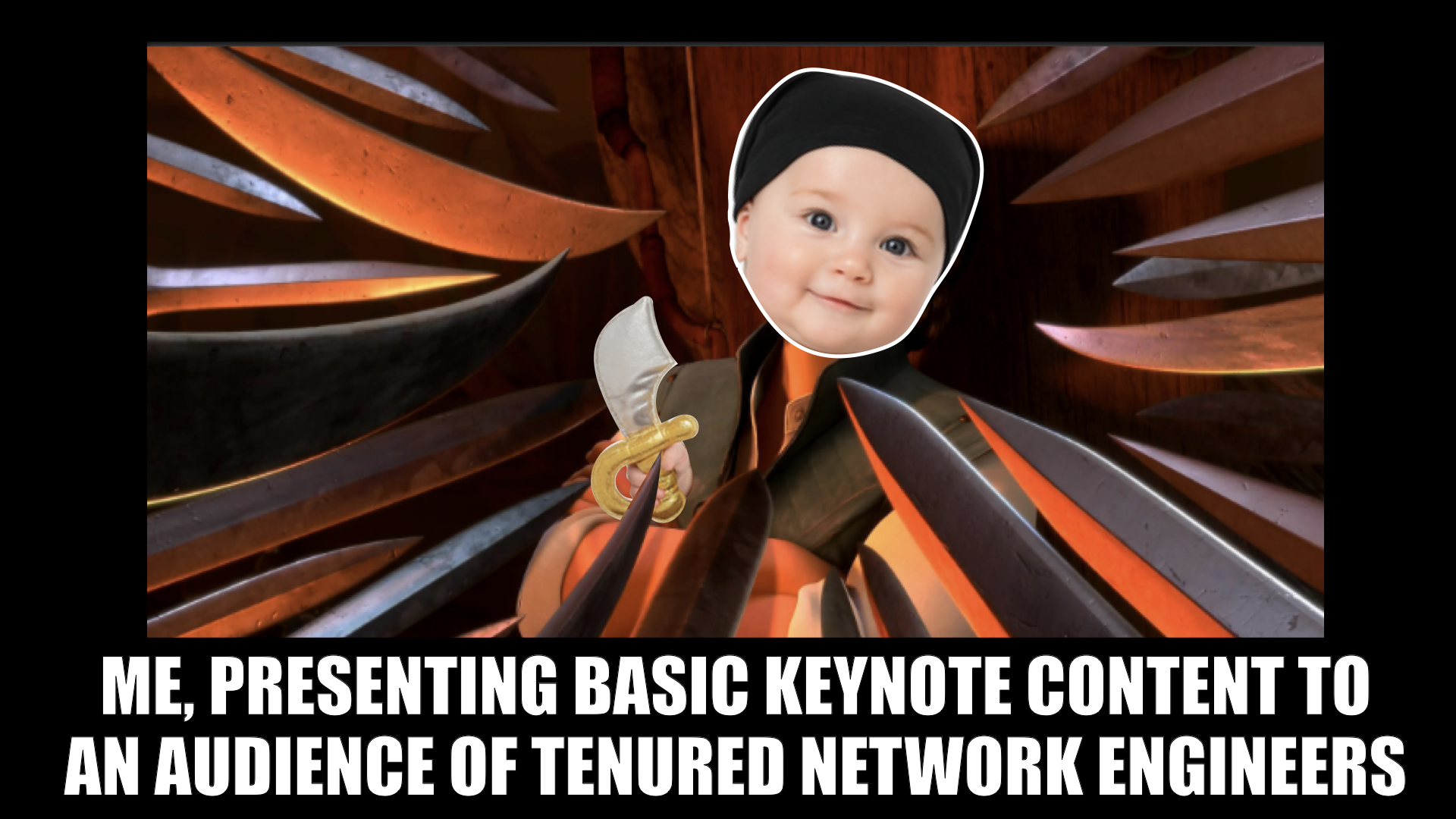
I decided to take on some of these Keynote requests to get an idea of what our learners actually wanted. One request was for a large group, fairly high in my organization. They wanted help making Keynotes that don’t suck. I asked for guidance and was pointed toward some retired presentation content. I pulled together some activities and prepared for the session. The audience was a group of engineers. “Surely, this will be easy, right?”
Chapter 2:

Black Friday

02

Our audience was in the hundreds, so I tapped a colleague to help answer questions in the Webex chat and mark attendance. That colleague was Bones. If you’ve read the GenAI case study, yes, that’s the same Bones.

I was working my way through a demo where we change all the labels on a chart one at a time, when a voice came from the virtual attendees.

“Excuse me, are we going to be doing anything more advanced? I expected this class to be a more advanced version, not just a how to use Keynote class.” A manager named Maynard’s thumbnail appeared on my screen.

I had years of experience teaching sessions on a tour bus for drunk tourists, so this interjection was nothing I wasn’t used to.

“Well, to be honest, this is what we shared would be covered in today’s session. Does everyone think this is too basic? If so, react with a Webex thumbs up.”

Thumbs up icons flooded my screen. I felt like a defeated centurion in the Colosseum, a sea of disembodied thumbs obscuring my vision. I took a breath, then said, “Ok folks, let’s pivot to the end. I don’t want to waste any more time.” I floundered through the rest of the content quickly and asked if anyone had questions.

At the end of the session, Bones and I were alone in the room. It was quiet. “Welp.” No other feedback was needed. We knew we missed the mark. To be fair, I did get a couple of Slack messages from folks in the class telling me they thought what we were doing was helpful, but I think they were just being nice.

We had a second session scheduled for a few weeks out with the same team. My contact set up another sync to talk about the original session and plan for the next one; four others were added, including Maynard, who spoke up initially. I pulled up my survey scores out of curiosity. It was a sea of very low marks, with some very sharp “this was a waste of time” flavor of comments.

I shared a document ahead of time where I wanted people to contribute learning objectives. What came back was a spaghetti bowl of different ideas. I went into the meeting with a group of strangers. My contact wasn’t able to attend. I kicked things off with “Hi everyone, let’s introduce ourselves.” We had a short, polite intro before Maynard spoke up again.

“Well, I just want to say I was really disappointed in the Keynote session. It wasn’t what we wanted and a complete waste of time.”

I acknowledged the comment and asked if anyone wanted to speak to the learning objectives they had shared in the document.

“I was really disappointed in the session, it was just about how to use Keynote. We know how to do that, so that was really frustrating.” Maynard continued.

At this point, I felt a strange power come over me. Inside, I was enraged. The comments from the class, the lack of guidance from my team, the fact that my contact wasn’t there. I snapped my mask on and said the following.

“Hi, yes, I understand the Keynote session was disappointing. I think we established that, and have made that point perfectly clear. We’re not here to relitigate the efficacy of the Keynote offering, we’re here to discuss how to make the next one better. So, did anyone want to share what they put in the document I sent over?”

Silence. Then my contact appeared. “Hey, I thought we were starting at the :45 mark?”

Oh, we had already started. We spent the rest of the session discussing ideas, and I agreed to run a presentation skills session where people would practice in small groups and give each other feedback. Everyone liked that, and we moved forward.

The second session was better received. Maynard was noticeably warmer. Here’s the thing: the delivery was brutal, but the underlying message was still valid, despite my ego. I knew we still had a lot of work to do.

Chapter 3:

Edward’s Story

03

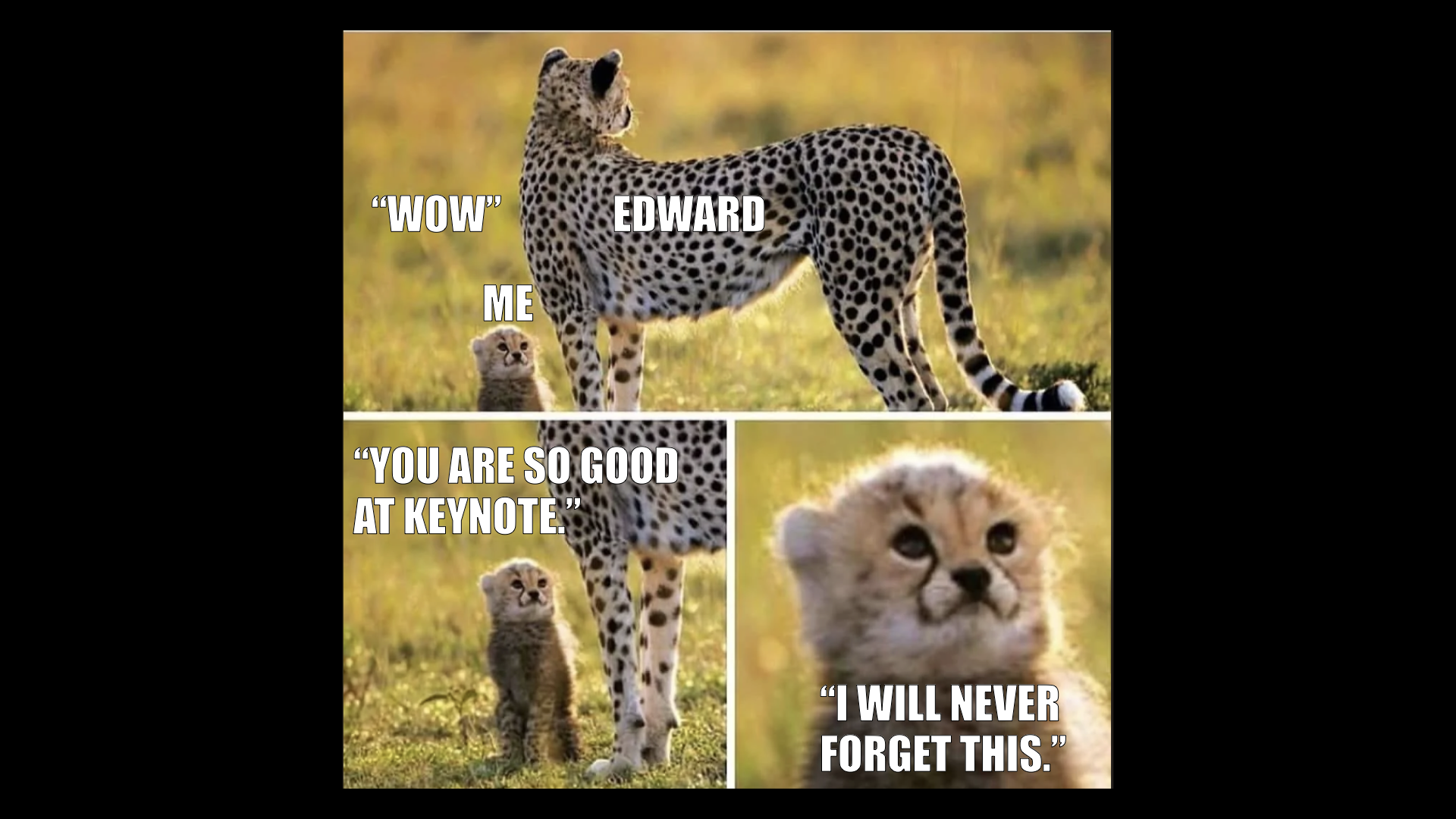
I set up a meeting with an old teammate, Edward. Edward was our Keynote expert, and he had built a very in-depth series of Keynote classes because he saw the same problem I did. Most Keynotes are boring, and we’re Apple, so we should make them better, right?

I had helped Edward with a light copyedit of some of his materials before, and I had co-taught his course with him for small groups periodically. We had a mutual respect for one another, and I was completely out of my depth with this approach to teaching Keynote. Edward had extensive material covering design, story, and presenting. In a perfect world, we could have launched a weeklong Keynote intensive.

I had 60 minutes. Anything longer would lose people, and anything shorter wouldn’t be effective. I worked closely with Edward, and he gave his blessing for me to borrow some of his content, mainly some of the talking points and a bulk of the activities. Whereas before we walked people through text boxes and formatting, now we talked about the why behind certain choices while sharing resources and addressing pain points.

I had the building blocks. Now I needed to test it on business units. I didn’t know what it would evolve into, but it was definitely better than what we had before.

Chapter 4:

Rebuilding the Ship

04

I was continuing to be assigned small group trainings about Keynote. Anytime someone got a request for a “more advanced Keynote” offering, they started being sent to me. I took it as an opportunity to test out some of Edward’s content. When someone requested a small group training, I would set up a sync with them to discuss what they hoped to learn and find a time on the schedule. With Edward’s content ready, I would ask if requestors were interested in Keynote content that focused on how to tell a story and how to design slides.

The answer was usually “That sounds great,” which is Applespeak for “Hell yes, brother.”

Over the next six months, I delivered dozens of custom Keynote sessions for small groups. Some would be the out of the box version, but some groups wanted to go deeper. I would ask folks to share examples of great decks or slides if they could, or find out if their org had a specific template. I took whatever they could share and reverse-engineered it for our audience. The way learners leaned in when they recognized a slide they had seen before, or an example based on work they actually did, was palpable.

“I’ve been at Apple for XX years, and that was the best Keynote class I’ve ever seen.” I heard that more than once.

Word started to spread. More teams wanted this course. I started delivering it for groups of hundreds via Webex. Some teams wanted me to come back and do Part 2. I knew it was time to scale.

The first step was to formally standardize the out of the box version. The class content was a living document I updated regularly, so it was time to have a primary version and make it official. We went through our full review pipeline, formally created a trainer guide and Keynote deck, and ramped up our trainers.

“I think this is out of scope,” one trainer said. The numbers disagreed.

“I know it’s a new approach, but I think this is filling a gap. If you like, we can go through the content together to address any questions you may have.”

Over the next few weeks I worked with our trainers to upskill them while formalizing the course into a class that anyone could sign up for on our internal LMS. The course was a 60-minute session: 30 minutes of story and design discussion, during which I would have learners share thoughts and answer open-ended questions, and 30 minutes of focused activities that reinforced the discussion. It was the product of six months of testing and dozens of custom sessions. After another few weeks, we were ready to launch to all of Apple.

Chapter 5:

X Marks the Spot

05

A few weeks after we launched the course, we started seeing sessions max out. We offered it initially once every two weeks, but soon moved to weekly and sometimes twice a week. Every session was maxed out for the first six months, and we were getting more and more requests for custom sessions from teams. This usually happened because one person would attend the class and immediately refer their teammates. Those teammates would have trouble registering because the sessions were full for weeks ahead of time, so they would request a custom session, which we would accommodate.

I worked with our global partners to scale the offering. EMEIA had planned to build their own version but ended up using what I built, adapted from Edward’s content. APAC had tighter time constraints for their learners, so I worked with them to adapt the session into two 30-minute sessions. That built some trust with that region, which led to us launching a shorter-form Keynote series in our own region a few months later.

By the numbers, this was the most popular elective class we had ever offered. Our team had an onboarding session with high enrollment, but new hires were automatically assigned to it. This class was a choice, and our learners chose to attend it, sometimes more than once.


Final Thoughts

While these numbers were validating, I realized after this project that it’s not possible to teach someone to be a compelling speaker in 60 minutes, especially in an elective, virtual class. The classes that actually made me a better speaker were in-person and required me to be vulnerable and humble about my current abilities.

There was one common trait I noticed when developing and teaching this course. Many folks view themselves as experts at presenting or Keynote, and in many cases they are very skilled. I don’t consider myself a presenting wizard, impervious to feedback. I think you can always learn something, even if you’ve done it for a long time.

In a way, we weren’t teaching people how to use Keynote. We were teaching them how to tell a story. A big ask for 60 minutes, but we got people closer. If I were to do it again, I would have advocated for a more robust, in-person Keynote masterclass. Small groups where everyone builds a deck, presents it, and we share honest feedback through a lens of kindness and humility.

Questions? Get in touch.